Showing posts with label privatization. Show all posts

Saturday, December 01, 2007

The Dawn of Corporatist Education

Opinion, The Jakarta Post, 1 December 2007
Published as "The Rise of Privately Funded Education" *

The delivery of education in Indonesia has long been operated by private educational institutions. But more recently, with increasing cost of running an educational institution and funding its programs, and decreasing government subsidies to support such costs, most educational institutions have to rely on private corporations to fund its educational programs. Even public universities have started to become privatized, while more and more corporations have established private educational institutions.

This article attempts to explore the social and cultural cost of privatization of education and the possible danger this may bring to the development of the society. The case of single corporations founding and funding private educational institutions will be discussed in more depth due to its mushrooming growth and especially alarming repercussions.

With the expansion of free market and its campaign for privatization, Indonesia is not the only country that faces the challenges of funding educational institutions. Even universities in the developed countries have to seek funds from the private sectors. Naomi Klein, in “No Logo” (2000) warns that researches being funded by private sectors can compromise the integrity of research findings. She cites a study that “found that companies maintained the right to block the publication of findings in 35 percent of cases, while 53 percent of the academics surveyed agreed that “publication can be delayed”” (Cohen, Florida, & Goe, as cited in Klein, 2000: 112-113).

In Indonesia, private corporations not only fund educational programs and research projects, but single-handedly found educational institutions, fund its whole operation, and seek profit from providing educational services to the society – creating educational systems that I would call corporatist education.

The term corporate university refers to educational programs and institutions founded by corporations to train their employees in core beliefs, operating and value systems of the corporations. But corporatist** educational institutes, the private corporations in Indonesia, go beyond this sphere to form and deliver main stream educational content to those who can afford their ‘services’.

While many of these corporations may found educational institutions out of sincere desire to contribute towards improvement of the quality of education in Indonesia, others may do so for more practical reason that rises from the simple equation of market demand. Still others attempt to bring in more fundamental vision to the kind of community and future generation they seek to form: the ones that would conform to their corporate beliefs and extend their reaches to more fundamental facets of our lives.

These latter corporatist educational institutions run the operation of their educational institutions very similar to the way they would run corporations – with cost benefit factors, marketing surveys, and the running of marketing and management of the institutions by professionals who may or may not have interests in the value of educational and academic quest for development of knowledge. In these institutions, students and their parents are customers whose demands must be met regardless of academic integrity.

Some of these corporatist educational institutions manage their educational institutions the way corporations would manage their offices and commercial areas: highly secured, gated, exclusive communities with their own privately run food courts, parking lots, and students’ dormitories. Every now and then, these institutions would run sponsored and marketing events where other corporations could promote their latest products to students. Some of them even look and feel like the malls, where people who ‘don’t belong’ won’t have access to the educational compound.

In describing the effect of corporate sponsorship to the “re-engineer[ing of] some of the fundamental values of public universities,” Klein mentions that “[m]any professors speak of the slow encroachment of the mall mentality, arguing that the more campuses act and look like malls, the more students behave like consumers” (Klein, 2000: 109).

To make matters worse, corporatist educational institutions polarize even more the already divided social economical classes of Indonesian society. In his book, “Manifesto Pendidikan Nasional” (National Education Manifesto, 2005), Prof. H.A.R. Tilaar describes the impact of consumerism to education: “… most of [national pluses schools] are very elitist because they are very expensive. This consumerist life style is highly contrasted with the everyday realities of many children on the streets, many of whom are homeless … and have no access to education. [It] has dampened our feelings … towards the poverty that majority of Indonesian society is living in” (Tilaar, 2005: 27).

To illustrate the above point, several weeks ago, I was invited give feedbacks to presentations by fourth-year architectural students from one of the corporatist universities. I was stunned by one particular presentation of a student’s point of view about an urban problem she observed, and was even more baffled by her proposal. She noted that the price of a pack of instant noodle was cheaper at Carrefour than at the (illegal) street vendors. However, the (legal) inhabitants by the railroad of the Mangga Dua area she investigated did not go to Carrefour because they had to take a roundabout walk or take the ojek (motorcycle taxi).

Her design proposal was a building that would bridge over the railroad track into the Mangga Dua Mall so the inhabitants could go directly to Carrefour. Thus, in her reasoning, the legal inhabitants of the area would no longer need to purchase items from the (illegal) street vendors or use the service of ojek – because “by law these (illegal) people would have to anyway be evicted from the area.”

In her argument against corporations sponsoring educational events and programs, Klein stated: “When corporations sponsor an event on a university campus [or school] … they cross an important line between private and public space – a line that is not part of a consumer’s interaction with a corporation as an individual shopper. We don’t expect morality at the mall but, to some extent, we do still expect it in our public spaces – in our schools, national parks and municipal playgrounds” (Klein, 2000: 445).

With the lack of national parks and municipal playgrounds in Indonesia, where social exchanges among different social economical classes could occur, educational institutions have become our last frontiers where ideal form of the society could be envisioned, discussed, debated, and continued to be developed. Yet, with the constant growth and encroachment of corporatist educational institutions, could we still hope for such public arena?

Notes
* This is the original, unedited version.
** Not in the original manuscript: The term corporatist is borrowed from Klein's "Shock Doctrine" (2007):

"Corporatism, or "corporativism," originally referred to Mussolini's model of a police state run as an alliance of the three major power sources in society - government, businesses and trade unions - all collaborating to guarantee order in the name of nationalism. ... an evolution of corporatism [can be defined as]: a mutually supporting alliance between a police state and large corporations, joining forces to wage all-out war on the third power sector - the workers - thereby drastically increasing the alliance's share of the national wealth" (Klein, 2007: 86).

Monday, October 08, 2007

From corpse to dust: One stop burying

In this age of hyper-commercialization, even burying process has become a one-stop service like many others. Within this context, what happens with burial rituals and traditions, and even the process of grievance? Does it matter anymore whether we understand the rituals and traditions we do, or do these have become so commercialized as well that we no longer can tell whether they are real or hyper-real?

***

My uncle passed away. It happened on early morning last Wednesday. When we went to his wake late that night after picking up my dad from the airport, his body was already deteriorating. His casket was closed soon after we arrived at the funeral house, after we were led through some set of traditional Chinese (Indonesian?) rituals which I knew nothing about. A worried thought overcame my mind as I blindly followed instructions from the guy in dark khaki uniform whose name tag pronounced him as Gunawan: What would happen when my generation, whose complete ignorance to all this rituals and traditions, took over?

As I went to my uncle’s wake night after night throughout the week until his cremation yesterday, folding papers to create different forms to be burned alongside my uncle, I tried to gain some information from Gunawan about the meaning of these folded papers. He said that the flat ones served as tokens for the evil spirits to let my uncle’s spirit passed easily into the next world; the rolled ones were the money he would need in the other world; while the ones he taught me to fold symbolized roofs of temples. When I asked why the roofs of temples, and where what about the bodies of these temples, he scoffed. But I found out later that he didn’t know the answer either. I asked him to teach me how to make the intricate lotus paper folding, but after teaching us the basics, he too had forgotten how to do it. So much for my attempt to learn about rituals and traditions, which would have been forgotten by the time my daily routine takes over again.

But apparently I need not worry about not knowing what to do with funerals when my generation eventually takes over. The funeral houses will take care of everything. My uncle’s whole burial process was fully organized by the funeral house. My uncle’s family only had to determine what type of burial they wanted (Buddhist, cremated), when they wanted to hold the flower and prayer night (Saturday, 9pm), when they wanted to leave for the burial ground (Sunday, 8am) and where to cremate him (Nirvana crematorium), all within the family’s budget.

The funeral house arranged for the deceased to be picked up from the hospital by an ambulance, provided the room, the casket, and an attendant (Gunawan) to lead through the chosen Buddhist rituals. On the flower and prayer night they even arranged for a group of Buddhist monk and social workers to lead the extended family, who only had to arrive at the predetermined time, through prayers which meanings only they understood. The same prayer group came again the next morning to lead the moving of the casket from the funeral house to the crematorium, with hired pallbearers, ambulance, truck, and traffic controllers all ready to help along the way. With such convenience, perhaps the hope was for the family to be able to focus more on commemorating the life of the deceased; or was it?

After more prayers and rituals at the crematorium, my uncle’s casket was put on a ceramic plate on an automated, fireproofed conveyor system that led it to the brick incinerator, while we stood beyond the enclosing tempered (showcasing) glass. Once the fireproofed steel door of the incinerator was closed, and the last of the cries and snivels subdued, we were told to sit and wait for two hours while my uncle’s body was cremated. Then out came water, snacks, fruits, and lunch boxes – which were soon consumed by my whole extended family over chatting, catching up, and even laughing out loud with one another. The funeral slowly turned into a family picnic to culminate in a boat ride.

Two hours later, the ceramic plate came out of the incinerator, with distinctly colored ashes (what I guessed as the remains of the casket, the flesh, and other things) and what’s left of my uncle’s still burning bones. Once the bones cooled down, my uncle’s family was handed giant tweezers – with which they could pick up my uncle’s bones, place them on steel pans, and hand them over to the attendants who grounded and placed the bones’ ash inside a small red sack, while the remainders of the ash were shoveled into bigger plastic sack. Throughout this process, the rest of us watched the rituals through the now open tempered glass doors: a showcase of cremation process, quite detached from emotions.

Several minutes later, we were all led to walk towards the conveniently located port from which we took a boat to the open sea, where my uncle’s ash was to be scattered. The precise moments and locations for when to throw papers, flowers, my uncle’s ash, and (take a deep breadth, environmentalists) the plastic and cardboard containers into the sea throughout the boat trip were announced by another man – who was telling us what to do as if he was reciting off directly from that memory strand of his.

By the end of that trip, no one was crying anymore. I wasn’t sure if it was due to the rather long bereavement process, or because the whole experience was just so surreal that we became detached from the fact that the whole procedure that was supposed to commemorate my dear uncle’s life had been conducted by orders of people who were strangers to my uncle.

My uncle was the second to go in my mom’s side of the family. Last year, another uncle passed away. He was buried the Catholic way, which was organized by the same funeral house. May they rest in their respective heavens, while we think about whatever will happen to cultures, traditions and rituals in this instant, convenient, and commercial age.

Tuesday, December 26, 2006

Have a Happy Holiday (Brought to You by ...)


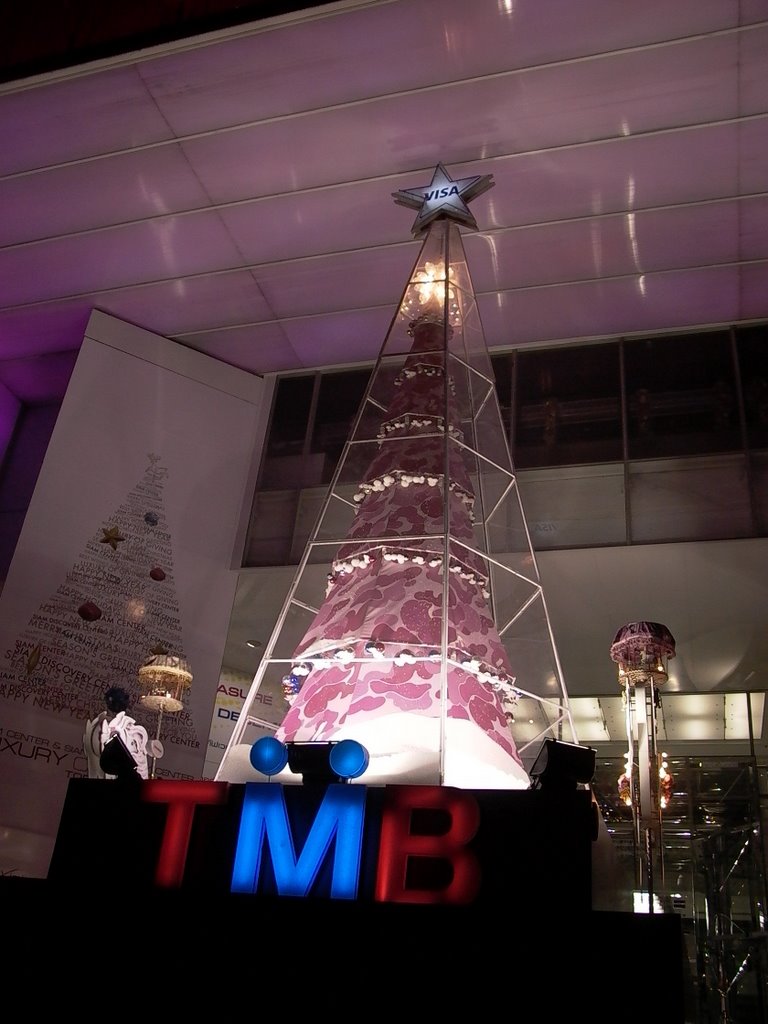
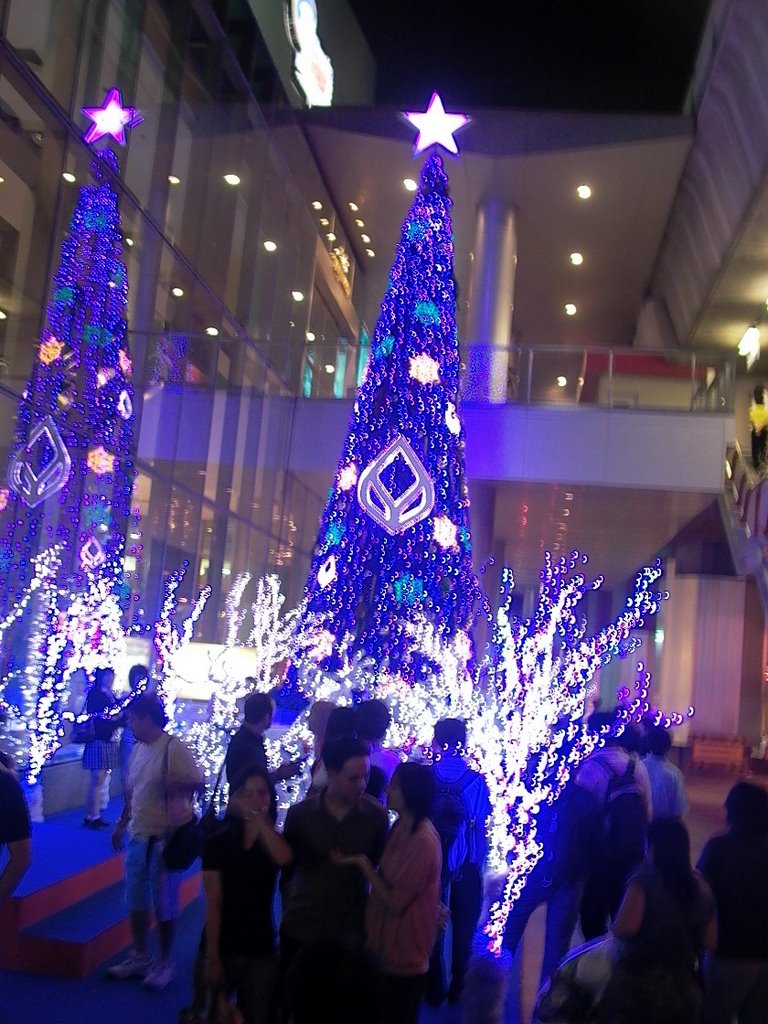
Apologies for the long absence from blogging. I'm currently in Bangkok, conducting research on Bangkok's urban poor. More to report later when I have access to internet on a more regular basis. But for now, here's some pictures of Christmas in Bangkok, in which Christmas is not even a public holiday, but where Christmas is nevertheless celebrated - however commercially. The stars above the trees are of the sponsoring banks.

On a more sincere end: Wishing all of you a Happy Holiday and a Happy New Year.

Friday, October 27, 2006

Have a Branded Ied

As if holiday season has not been commercialized and transformed enough with mobile technology, here’s a text message I received from a friend that captures it all :)

Hatiku mungkin gak sebening XL atau secerah Mentari.
Banyak salah yang kubuat.
Fren, kuminta Simpati-mu.
Bebas-kan aku dengan maafmu.
Selamat Idul Fitri 1427H.
Semoga amal ibadah kita mendapat acungan Jempol di mata-Nya.

Friday, October 13, 2006

Just for Fun

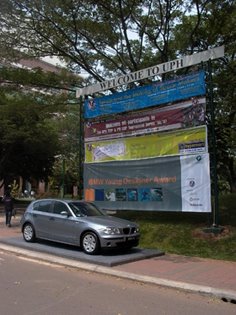
Take a good look at this photograph.

Yup, you got that right! It’s the new BMW 116i being showcased in front of the main gate to UPH’s campus. If you think that the two image don’t seem to belong together, and the campaign seems a rather early induction for a desired life style, you may want to think again :)

Sunday, September 24, 2006

Libraries as Doors

A competition brief for City of Stockholm public library:
“Libraries should be door-openers showing visitors new ways of learning and experiencing, as well as maintaining and reinforcing their own cultural capital in a variety of ways.” [Added italics].
Contrast that with this comment from Raynata:

"... Have you gone the library now? Now we've to leave all our stuff in the locker... "

in this posting. In this case, the library is door-closers showing visitors only one way of learning and experiencing: you have to belong to the university and you must relinquish all your belongings to access it :)

Monday, September 11, 2006

University Makes the Society

In this previous posting, I ranted about recent security measures taken by Universitas Pelita Harapan (UPH). So what is my problem?

When I think about the word university, I think of a place where learning is shared. According to Wikipedia:
The word university is derived from the Latin universitas magistrorum et scholarium, roughly meaning "community of masters and scholars".
The great architect/ philosopher Louis Kahn stated:

“School began with a man under a tree, who did not know he was a teacher, discussing his realizations with a few others, who did not know they were students. The students reflected on the exchanges between them and on how good it was to be in the presence of this man. They wished their sons, also, to listen to such a man. Soon, the needed spaces were erected and the first schools came into existence. The establishment of schools was inevitable because they are part of the desires of man.”
Kahn, who designed Salk Institute (commissioned by Jonas Salk the inventor of polio vaccine), considered educational institutions as:

… “the houses of the inspirations” – places defined by the fundamental inspiration to learn and by concomitant need to shelter learning within a supportive community.”
Brownlee & De Long, “Louis I. Kahn, In the Realm of Architecture”, Rizzoli, New York, 1991: 94.

As a university, UPH by Kahn’s definition is also one of “the houses of inspirations”. Yet, by being such an exclusive, highly-secured compound on an already homogeneous Karawaci, what kind of inspiration does UPH seek to foster from its students, staff, and community? That university and its graduates should set themselves apart and away from the society?

Granted that UPH is a private university, but there are many private world-famous universities that share its facilities to the public. Even after 9/11, private universities in the US like Harvard and MIT still keep their doors open and unguarded. On my visit to these two institutions last October, I could stroll around the university compound, and entered some of their buildings and libraries without anyone asking me to show an ID. Even MIT’s relatively new Stata Building designed by Frank Gehry that housed the Computer, Information and Intelligence Sciences was very accessible down to its private offices.

The strictest entry I encountered was to Harvard’s Fine Arts Library. It was secured by metal detectors and security guards at entry points to check whether or not one belonged to the university. This security measures, however, was due to the library’s connection to Fogg Art Museum that showcased valuable art works. Even so, when I, as an outsider, wanted to go inside the library, all I had to do was to check in at the front desk to get a guest tag, and I was allowed to roam the library for the whole day.

UPH should aim to do as Kahn maintained:
… Community making was also one of mankind’s – and the architect’s – chief responsibilities. … [He added:] “I don’t believe that society makes the man. I believe that man makes the society.”
Brownlee & De Long, “Louis I. Kahn, In the Realm of Architecture”, Rizzoli, New York, 1991: 94.
Likewise, university makes the society.

Let’s not leave universities to resemble this excerpt from Wikipedia:
“Bill Readings contends in his 1995 study The University in Ruins that the university around the world has been hopelessly commodified by globalization and the bureaucratic non-value of "excellence." His view is that the university will continue to linger on as an increasingly consumerist, ruined institution until or unless we are able to conceive of advanced education in transnational ways that can move beyond both the national subject and the corporate enterprise.”


Sunday, September 10, 2006

When University Starts to Resemble Mall

In this past month, something has been bothering me every time I go to teach at Universitas Pelita Harapan (UPH). I knew it right away when it started: the beginning of the school year back in August. Prior to that time, whenever I drove my car into the designated parking area for staff and lecturers, a security guard would greet me and give me a parking card after he ensured that I had a pass to park in the area. But on that August morning, after the two-months break, I didn’t see just one guard, but another two who opened the doors and trunk of the cars queuing in front of mine.

Great, I thought to myself. The security checks had finally caught up with this university! But I didn’t put much thought into it, simply because we all had gotten so used to security checks in our ways around Jakarta. I got out of my car, and went through my usual route towards Building B, where the Department of Architecture was located. And there were two other security guards, standing in between the gates that separated the parking area from the university compound, checking bags of students who were walking ahead of me.

Fine, they wanted to do a comprehensive security check. Again, I didn’t put much thought into it because I was more concerned about getting into my studio and met my new students on the first day of school. After an introductory workshop, I went out of the compound to have lunch with other lecturers. And again, there stood two security guards in front of the gate, checking everyone’s bag. I asked my full time lecturer friend when they started doing the security checks at all entry points. My friend told me that it happened when UPH Festival was held about two weeks prior to beginning of school year.

Because I had borrowed some books from the library over the break, I decided to go there. Besides, I wanted to check out the library since it had been relocated into a new building. And there I saw the new building that had been scaffolded during its months of construction. The street level was almost completely open, and it had a big sign “FJ Square” on its front. I asked my friend again, what did FJ stand for? He had no idea. But apparently it’s the new food court.

What struck me most about this food court was its stark contrast with the old one they demolished about two years ago now. The old food court was an open air structure, with many stalls that were rented out, most were modest and sold food that was pretty affordable for students. But this new one was not like the old one. This food court could easily belong to any of the luxurious malls in Jakarta. The price, even after 25% discount for UPH students, was still rather expensive. Some of my students told me that they could not afford eating there. In August 2006 edition of Umbul-Umbul (Karawaci’s monthly complimentary magazine), I found out that FJ Square was modeled after the Food Junction in Singapore.

Because I had eaten lunch, I didn’t stop by the food court, and instead went straight to the library, which was located above the food court. I was told by my friend that as part of the new security system, all UPH students and staff had been required to possess a “smart card” which would let security guards quickly identify whether or not someone belong to the university. Now apparently, this “smart card’ was needed to enter the new library. Because I didn’t have one, I couldn’t even open the door of the new library!

As if having the “smart card” was not enough a security measure, there stood yet two other security guards in front of the door, ensuring that people with no “smart card” like me could not pass through the door by tailgating the person in front of me. After my friends ensured the security guards that I was indeed a lecturer there and I was asked to show my old library card, I was finally let in to the extremely luxurious library.

I said extremely luxurious, because the spaces between the aisle were around one meter or more. It’s fully air-conditioned, and here and there I saw genuine leather sofas that must had cost hundreds of millions of Rupiah to purchase! And when I walked towards the back of the library, the space was open, naturally lit, and had full horizontal windows opening to a view of rather undeveloped area of Karawaci.

But the very unfortunate fact was that the books I found remained the same unimpressive ones. Most of the architectural books were still the coffee-table books that you could typically purchase from book distributors, rather than those that you purchased in bookstores and through Amazon after you browsed through hundreds of them to determine which ones were of better qualities than the rest.

Done with checking the books, I decided to leave the library through the same doors that again were now guarded on the inside. I nodded confidently as I passed through the guards, and pushed the door in front of me. And I couldn’t open it! The guards started to surround me, which for some reason made me feel a bit panicked. They started asking me to use my “smart card”. So once again I gave them the same explanation that I gave to the two guards just outside to the right of the exit door. And they finally let me out.

On my way out of the university compound, I was struck by the unpleasant experience of the day. I kept thinking: Why would they not let anyone out from the library after they had ensured that whoever got in did belong to the university and had the right to be there? What would happen if there was fire and people were inside the library? Had the security of the university been breached over the break that made decision makers at UPH decide to intensify the level of security?

My experience at the university has started to resemble my experience in going through malls – and worse. I think a university shouldn’t be this way. But I couldn’t formulate what exactly is troubling me, except that I dislike the malls for this reason. But after having this issue at the back of my mind, found the least secured path into the university compound, and avoided going to the library for a little more than a month, I could finally pin point what the problem is. More on here.

Monday, July 17, 2006

Public space and social demarcations

Jakarta Post, Opinion and Editorial, March 18, 2006

When was the last time you were in a public space in Jakarta? If you don't use public transportation and hardly walk or bike on the streets of Jakarta, you might start thinking about malls, dining places or other entertainment places inside offices, hotels and other commercial complexes. Or you might think about parks, sports facilities, or other public areas including the streets inside your housing or apartment complexes.

You may want to think again, because all of these places may not be true public spaces, in the sense that they are not accessible to everyone. In other words, most malls, offices, hotels and other commercial complexes are privatized public spaces. Even when you spend hours of your time on Jakarta's congested streets inside your car -- you are in private property in a public space.

True public space in Jakarta is rarely frequented by members of the upper (or middle) class, while privatized public space is exclusive. The result, I am afraid, is further demarcation between the upper and lower classes of Jakarta.

Bestuzhev-Lada categorizes public space for leisure activities as "places for contemplation (religious buildings, parks, embankments), places to obtain new information (museums, libraries, exhibitions), places for creative activities (clubs, daily centers, etc.), places for sports activities (stadiums, sports centers), places for entertainment (dancing/concert halls, theaters), and places where public holidays are celebrated (squares, streets)" (Bestuzhev-Lada, 1972, in Gabidulina, 1994). Nowadays, it is questionable which of these places have remained true public space, as some, if not most of them, have been privatized.

What makes a public space privatized? Margaret Crawford reveals that the designs of most malls attempt to "create essentially a fantasy urbanism devoid of the city's negative aspects: weather, traffic, and poor people". She adds that malls are heavily patrolled to ensure safety of their homogeneous clientele by exclusion of others (Crawford, 1992).

Trevor Boddy, in arguing against privatized skyways, specifies that "two forms of policing kept the skyway system a haven of middle-class propriety: formal, by police officers at key entrance stairs and security guards in lobbies, and informal, through the visual codes and cues indicating that anyone not dressed appropriately or behaving in an acceptable manner is unwelcome" (Boddy, 1992).

The fast growth of malls in Jakarta after 1998 is linked by Abidin Kusno with "looseness" of power which triggers the feeling of insecurity among the formerly protected upper-middle class of Jakarta (Kusno, 2004). Malls have become safe havens for the upper-middle class, and I would include all privatized public space in this category.

Even when the upper (and some middle) class leave home (inside a housing or apartment complex), they are most likely moving around Jakarta in a private car, going from one private property to another without being part of public space. Being in the car, they are physically separated and psychologically removed from the activities and the people on the street by sheets of tempered glass and galvanized metals.

The car windows become screens though which the city is passively viewed, rather than a space in which we can actively participate. The city, the streets and the people outside become images, not too different perhaps from what we have seen on other screens like computers, televisions, movies. The public space is seen and experienced as visual stimuli -- the unwanted aspects we can both consciously and unconsciously filter or ignore.

Children from upper (and some middle) class who are born post-1998 are most likely growing up within homogeneous communities. They could become unaware of, insensitive toward and immune to lower-middle classes that are excluded from places they encounter in their daily lives. Nowadays in Jakarta, the only possibility for interaction among different socioeconomic groups of children are organized by schools under the umbrella of community work.

The way we design, use and experience Jakarta's public space has remarkably influenced our social interactions, and will surely have social implications. If we maintain the present conditions, we can only imagine the effect on the growing class division.

Fortress mentality leaves Jakartans isolated, fearful

Jakarta Post, Opinion and Editorial, January 21, 2006.


A home should be a safe abode, thus security is important. A common solution to the security of Jakartan houses is to put bars on the windows facing the street. After the May 1998 riots, the use of security bars has proliferated, with all open spaces being covered, making their occupants feel caged in their own homes. Housing complexes that have been developed over the past ten years are more likely to be surrounded by three-meter walls, and can only be entered through secured gates.

Older middle-upper housing complexes, on the other hand, are not gated. I will argue that it is precisely this openness and inclusivity towards other racial, social and economic groups, that has strengthened social security.

Gated communities aim to exclude "others". Most of them don't allow street vendors and those who "don't belong" to enter the complexes. Caged-in houses can even be found within these complexes. It seems that the fear of "others", traditionally addressed towards those of a different race, social or economic status, has extended itself to become a generalized fear of everyone, period. The implication of gated communities is that they create pronounced social, economic and, in most cases, racial enclaves, that are in fact far more likely to trigger resentment and thus cause insecurity.

Mike Davis in City of Quartz (1990) suggests two reasons for explaining the phenomena of house fortresses in Los Angeles. "In the first place, the market provision of 'security' generates its own paranoid demand. 'Security' becomes a ... prestige symbol. Secondly, as William Whyte has observed of social intercourse in New York, 'fear proves itself'. The social perception of threat becomes a function of the security mobilization itself, not crime rates." Post-1998 housing complexes in Jakarta reveal similar paranoia, with security becoming a commodity rather than a real need against crime.

Older middle-upper housing complexes, such as Menteng, Kemang, and Permata Hijau, have no clear boundaries with plenty of open pedestrian and vehicular access to the surrounding (kampung) areas. According to David Hutama, an architect in Jakarta, the areas of Pulomas, Kayu Putih, Taman Buaran Indah and Bintaro are also ungated, and remain this way to this day.

Occupants of these complexes, although mostly from middle and upper social and economic groups, are racially mixed. Permata Hijau is considered by many as one of the most prestigious housing areas in Jakarta. Yet, here and there, smack right up against huge, multi-billion-rupiah houses, are informal settlements ranging from low-income houses, warung, and informal businesses.

Some security measures are taken. Security posts can be found at almost every other intersection, some streets are closed off after 10 p.m., and some houses even have their own security guards. But apart from that, Permata Hijau streets are open to kaki lima and kampung dwellers, some of whom work in or provide services to these houses, while others simply hang out. Some of the streets and vacant lots are even appropriated as public space where kampung dwellers play soccer or volleyball, while others are privately used as gardens maintained by kampung dwellers.

The welcoming stance towards the kampung dwellers brings a sense of belonging to the area that in fact helps prevent crime.

Clearly, securing our homes can be done effectively without the need to live in a fortress. Jane Jacobs proposed in The Death and Life of Great American Cities (1961) that the problem of insecurity can be solved by three means.

First, there must be a clear demarcation between what is public space and what is private space.

Second, there must be eyes upon the street; eyes belonging to those who we might call the natural proprietors of the street.

And third, sidewalks must be in continuous use by pedestrians.

As most houses are gated anyway, demarcation of public and private space is already clear in most cases. However, if you happen to drive through any of the newer housing complexes, the streets are almost vacant. Gated communities create a environment that alienates and excludes others.

This is not the case in Permata Hijau, and most other older housing areas, where the inclusion of dwellers has created natural proprietors who use the streets fairly continuously, and whose "eyes" are always present.

These older complexes demonstrate that it is not necessary to exclude pre-existing and surrounding communities. Moreover, open complexes create mutual benefits for both dwellers of the housing complexes and those from surrounding communities.

Malls as “Public” Places (?)

The popularity of shopping malls as hang out places may very well be a global phenomenon. Yet, in the case of Jakarta, the utilization of shopping malls as “public” places has been intensified by the growth of commercial areas, diminishing green areas, and privatization of public places.

Panangian Simanungkalit indicated that in 2005 alone, commercial areas (shopping malls, supermarkets, and trade centers) in Jakarta reached the total of 5,100,424 square meters (Kompas, 21 April 2006: 46). Meanwhile, Nirwana Joga pointed out that Jakarta’s green area has been reduced from 37.2% of total area in year 1965-1985, to 25.8% in year 1985-2005, to 13.94% in year 2010 (Joga, 2002). Currently Jakarta’s green area is merely 9.67 percent of total area according to Yayat Supriatna (2004).

Some of green areas have been converted into malls (Plaza Senayan, Mal Taman Anggrek, and Mega Mal Pluit), five-star hotel (Hotel Mulia), upper-middle housing complex (Pantai Indah Kapuk), and even government’s office (Kantor Walikota Jakarta Selatan; Joga, 2002). Even the National Monument (Monas) is no longer accessible for all citizens. The renovation of Monas surrounded it with four meter gate, making the public space inaccessible to underclass citizens – hawkers, panhandlers, and prostitutes.

Interviews conducted with 154 random visitors to five malls in Central and South Jakarta reveal that they visit the malls between two to four times a week for eating (71.43%), watching films (50%), strolling (25.32%), working out (24.68%), conducting work-related meeting (24.03%), shopping (20.78%), and people watching (7.79%). This result indicates that, firstly, shopping is actually not the main intention for most mall-goers; and as such, secondly, these activities do not have to be conducted in shopping malls. So why do people go to the malls?

My argument is because they have no better choices. Malls and other commercial areas are more profit-generating and easier to maintain for developers than culturally-oriented and socially-mixed public places. Yet, these commercial areas are targeted towards specific customers: they segregate people according to social-economical backgrounds. 57.11% of interviewees in my samples are professionals, 32.47% students, and 9.09% house wives. Only 1.23% is in the service sector, and no respondents are member of the working class or in agriculture. The malls where interviews were conducted are not targeted for these “other” classes.

In the case of Jakarta, and of Indonesia to a larger extent, the impact of homogenous and exclusive commercial areas is especially alarming. Many areas in Indonesia have, historically and repeatedly, experienced social unrest caused by clashes between different ethnic, religious, political, and social-economical groups. Casual interactions between different groups of people, including those from different social-economical classes, are often mediated by open public spaces, safe public transportation, and streets with good pedestrian sidewalks. Unfortunately none of these public amenities are available in Jakarta. Jakarta, therefore, desperately needs to re-create its public places, where people from different backgrounds – or at least those who want to – have the options to mingle.

A specific tenant within the malls, cheaper price, and traffic condition to and surrounding the area are other particular reasons the interviewees go to malls. The specific tenants are not just department stores or supermarkets, but also cinemas (50%), fitness centers (24.68%), and bookstores (14.94%). Some 13.64% mention certain ambience of the malls, and 7.14% actually conduct job-related activities in addition to 24.03% of meeting with clients. These very specific reasons indicate that some people have the desire to be culturally entertained and others to be healthy. They appreciate the design and cultural atmosphere being offered by a specific mall. Some even go to the malls to gain knowledge.

Of five malls in my samples, the one that attracts most visitors is located in prime location, easily accessible both by using public and private transportations, and has variety of tenants which cater to different ages. A successful future public places in Jakarta will have to equal, if not exceed, these criteria while avoiding homogeneity. Yet, this may remain a utopian hope for Jakarta, if one particular stand has not changed.

Privatization of public places indicate that Jakarta’s local, regional, and national government need to, first and foremost, have the political will to put forward issues related to public needs – rather than submitting to short-term financial gain, but losing the long-term battle to realize a functional, healthy, society. If this is not a possible expectation, then citizens of Jakarta will have to wait and hope that there will be private enterprises that develop commercial sites that also put forward public concern.


This article is part of paper submitted for “Arte-Polis: Creative Culture and the Making of Place”, an international seminar organized by Institut Teknologi Bandung.