Showing posts with label impressions. Show all posts

Tuesday, May 27, 2008

My Passion (for Markisa) Fruit

Image source

The months of May through August (or what used to be known as the dry season in Indonesia before climate became quite unpredictable worldwide) bring a certain delight for markisa (passion fruit in English, maracuja in Portuguese, maracuya in Spanish) lovers. I have only become recently addicted to markisa, but I have mostly been absorbed by the beauty of this fruit's structure and texture - which very much heightened the experience of eating this tangy and juicy fruit.

I enjoy cracking the hard outer shell, carefully turning the fruit around its cross section until the brown-dotted-yellow cracks, revealing an inner white and soft shell with the thickness and texture slightly denser of a cotton square. The spongy second shell needs a bit of a tension, instead of a compression, to rip open, which action most likely burst the third thin, translucent, elastic inner layer membrane. Hundreds of soft black seeds clung onto tiny clasps that are embedded onto the inner side of the membrane, organized neatly along three columns that run across the long section, from the tip to the bottom of the fruit. The space in between the three columns is exactly the lengths of two pulps. The black seeds are dulled by their transparent flesh casing, all carefully tugging themselves onto the clasps along the three columns, filling in completely the space within the ovoid fruit.

The fruit is a biological marvel that reminds me of D'Arcy Thompson's On Growth and Form. And although I have never seen markisa flower or plant, it looks very exotic on pictures.

Image source

Here is a more technically accurate description of the fruit:
The nearly round or ovoid fruit, 1 1/2 to 3 in (4-7.5 cm) wide, has a tough rind, smooth, waxy, ranging in hue from dark-purple with faint, fine white specks, to light-yellow or pumpkin-color. It is 1/8 in (3 mm) thick, adhering to a 1/4 in (6 mm) layer of white pith. Within is a cavity more or less filled with an aromatic mass of double-walled, membranous sacs filled with orange-colored, pulpy juice and as many as 250 small, hard, dark-brown or black, pitted seeds. The flavor is appealing, musky, guava-like, subacid to acid.
Maybe I just miss a bit of an architectural talk :)

Tuesday, January 08, 2008

The Miseries and Pleasures of Toilets


Fear the Chinese, declared my sister upon the conclusion of our recent trip to Western China. Not because they are the growing, massive, hard working nation to watch out for, but because of their ability to endure harsh, unsanitary lives on a daily basis.

As I do a quick run over the internet on Chinese toilets, it becomes apparent that many people have written about their experiences in China specifically because toilets seem to make a visit to China most memorable. And memorable it is. As I am flipping through the images I found online, the inner of my stomach squirm, and the vision and stench of the last few public toilets I forced myself into spring up unrepressed, regardless of the fact that I did stuff tissues on my face and tried to intake as little air as possible.

Against my initial inkling to publish some pictures along with this entry, I have decided to spare us the more explicit visions and my own verbal but very graphic description of my experience. Instead, here is a highly sarcastic, hilarious entry – albeit the fact that the writer should consider himself lucky not to have encountered some of the much more horrible ones these.

I can’t help wondering why so little attention is given by the Chinese to the hygiene of their toilets, although I should note that the government seems to be making some efforts by giving stars to cleanliness of public toilets, and contrasting it to the very memorable passages from Junichiro Tanizaki on the same subject:
Every time I am shown to an old, dimly lit, and, I would add, impeccably clean toilet in a Nara or Kyoto temple, I am impressed with the singular virtues of Japanese architecture. The parlor may have its charms, but the Japanese toilet truly is a place of spiritual repose. It always stands apart from the main building, at the end of a corridor, in a grove fragrant with leaves and moss. No words can describe that sensation as one sits in the dim light, basking in the faint glow reflected from the shoji, lost in mediation or gazing out at the garden. The novelist Natsume Soseki counted his morning trips to the toilet a great pleasure, ‘a physiological delight’ he called it. And surely there could be no better place to savor this pleasure than a Japanese toilet where, surrounded by tranquil walls and finely grained wood, one looks out upon blue skies and green leaves.

As I have said there are certain prerequisites: a degree of dimness, absolute cleanliness, and quite so complete one can hear the hum of a mosquito. I love to listen from such a toilet to the sound of softly falling rain, especially if it is a toilet of the Kanto region, with its long, narrow windows at floor level; there one can listen with such a sense of intimacy to the raindrops falling from the eaves and the trees, seeping into the earth as they wash over the base of a stone lantern and freshen the moss about the stepping stones. And the toilet is the perfect place to listen to the chirping of insects or the song of the birds, to view the moon, or to enjoy any of those poignant moments that mark the change of the seasons.

Junichiro Tanizaki, In Praise of Shadows, 1977, Harper T.J. & Seidensticker, E.G., Trans., 1991: 13-14.
Now I have never been to Japan to check whether or not its public toilets are as sanitary as Tanizaki mentioned, but his passages, which I first read while studying architecture and laboriously attempted to achieve in my designs, impressed upon the importance of cleanliness to create such a pleasurable, sensual, and phenomenal toilet experience twice.

Why such difference in appreciation towards the act of exerting our bodily waste?

Wednesday, November 07, 2007

Indonesian Unemployed Youth: Culture or Laziness?

In discussing the state of Indonesian education with a colleague recently, I was reminded by this statistics in Naomi Klein’s “No Logo”: “Youth (age 15-24) unemployment as a percentage of total unemployment in Indonesia was 72.5% in 1996”. I was shocked by such a high figure, the highest in the list as a matter of fact. As a comparison, in 1997 the percentage was 45.4% in the Philippines, 35.9% in The United States, 29.9% in The United Kingdom, and (the lowest was) 12.2% in Germany (Yearbook of Labour Statistics, from 1980 to 1997, International Labour Office, in Klein, N. 2000: 532).

My hope is that the social safety net in Indonesia is really good, so much so that it allows most teenagers to be dependent upon adults financially. Or is it our culture? Only recently it has become socially OK for Indonesian high school and university students to be employed while going to school. Or maybe the statistics couldn’t get into account the thousands (millions?) of Indonesian youths who work in the informal sectors. Or, to take on the opposite stand: Are Indonesian youths lazier than those in the rest of the world? Or they simply lack the opportunities, education, skills, and systems that could help boost their employability? What’s your take on this?

If you’re wondering if the statistic is still the case in Indonesia, this is what I found: 70% of total unemployment in Indonesia is (still) represented by the youth generation, according to SMERU’s report on “Reducing Unemployment in Indonesia (2007) as quoted in this Media Indonesia article (in Bahasa).

Sunday, July 08, 2007

One Degree of Separation, Virtually

We blog for different reasons, one of the main ones is to share our ideas with the wider public instantly, or almost as soon as we come up with the ideas. And it seems that this desire to publish may link with the vanity to know how far our ideas spread and influence other people which, with the help of search engines, is not that hard to track.

Take for example Puspa mentioned Greg Mankiw, who tracked down the post through a search engine, and created link to Puspa's post, which later being linked to Muli's (Puspa's brother) post here – where I found out about the circuitous linkage.

Or my own quotation of Paulo Coelho in an article for The Jakarta Post, who tracked down the internet link and post this in his own blog, which I tracked down through another search engine, and create this post to link it back to Coelho’s post.

Has six degree of separation been reduced down to one degree of separation in the virtual world of great wide web with internet as an interface? The Wikipedia post doesn't seem to suggest so.

Friday, June 01, 2007

2030

President Yudhoyono has launched a vision for Indonesia: by 2030, Indonesia will be among top five economic powers in the world. In the past three days, Kompas published a seminar that attempted to relate this vision with education. The second article in the series is of interest in this post. In it, the article stated that the vision, albeit feasible, is impossible to achieve by 2030, considering the current state of affairs in Indonesia.

It begs the question of why bother having a vision when it is not achievable? Sure, in their highly influential book Built to Last, Collins and Porras stated that visionary companies (interchangeable with countries) should aim to have a Big Hairy Audacious Goal. But implicit in their argument is that the vision should be achievable.

In a current research initiated by British Council, conducted by partnership between Bina Nusantara University and Forum Grafika Digital to map packaging, promotion, and publication industries, I was informed that Indonesia does not even have data on the service industries yet – a fact that although is not surprising is nevertheless detrimental towards the 2030 vision.

When the more advanced countries in the world have moved on from industrial era, to informational age, to service industries, and to knowledge economy at present, manufacturing industries are still Indonesia’s most valuable industries. Service industries don’t even count.

Without attempting to be pessimistic and cynical (although it’s hard not to be both considering the state of affairs), how on earth will Indonesia be among top five economic powers in the world by 2030? The Kompas article mentioned that at present Indonesia is not even in the top twenty. So why not set an achievable vision instead, one that although may not be as great as the 2030 vision, but is more likely to set up smaller steps towards being on the top five?

ADDED
In Changing Minds, a book I currently read, Howard Gardner wrote:
"... while stories [referring to any ideas put forward by leaders] need to be dramatic, motivating, memorable, picturesque, even garlanded with appropriate music and graphics, they also need to be honest. That is where integrity comes in. Stories that do not resonate with reality ultimately prove frustrating and ineffective." (my emphasis, p.112)

Wednesday, April 18, 2007

The Meeters, The Callers, and The Netters

Do you ever wonder why some people seem to be un-detachable from their cell phones, some must get connected to the internet very often if not most of the time, and others don’t get attached to either, but seem to be with people all the time?

Recently it dawned on me that people can be categorized into three groups according to their preferred means of communication and coordination with other people.

The first group consists of those who love meetings. Call them anytime of the day, or ask them what they do over the weekend, they are mostly with other people, be it at meetings that more than often are not in their offices, at this or that restaurants or cafes, or visiting this or that friends. For identification purpose, people who belong in this group are The Meeters.

The second group consists of those who prefer talking on the phone. You would never see them without their cell phones and if for one reason or another their cell phone died, they would get rather jittery. Some people within this group have more than one cell phone for the circumstances that should one died, the other would still function. And they know very well the price wars between different providers and have updated knowledge on what kind of packages are cheaper for making phone calls or text messages to which numbers and areas. We’ll call them The Callers.

The last group consists of those who get very anxious and even cranky if they don’t check their email every day. They are happiest when they can be connected to the high speed internet. They would be happy working away in front of computer screens, and they could sit for hours and hours without getting bored. They would go to a lot of extent to avoid meetings and calls and much rather use text messages, emails, or chats. Meet The Netters.

If you want to communicate and coordinate with the Netters, they would ask you to email them. And in turn, they would text or email you and would only call if you don’t respond to their text or email messages. Try The Callers, they would say: “Call me”, or they would call you up and try to solve things over the phone. The Meeters’ first response would obviously be: “Let’s meet” and you will have more meetings in longer time that you could possibly expect – at least for The Netters.

If you are dealing with The Meeters, don’t try to communicate with them through text messages, emails, or chats – especially if you have something urgent to discuss. At the very least you should call them and ask whether or not they have read your messages. In meetings, rather than giving them soft copies, give them hard copies. They need to see people and things to get the message through.

Along a continuum, The Meeters and The Netters are at the opposite ends, with The Callers in between the two. Meeters can be Callers, Callers can be Netters, some Meeters can be Netters, but most Netters are definitely not Meeters.

But then again, what do I know, I'm a Netter, I don't meet that many people to be able to categorize them all within these three narrow categories.

Wednesday, April 11, 2007

Western Lords, Frustrated Artists, and Pigeon-Holed Workers

Several weeks ago I went around some cities to visit arts and design industries, communities, and schools. I thought the visits to the universities would be most interesting, but as it turned out, the visits happened towards the very end of the week so most of the schools were rather quiet and one was in dilapidated condition. Nothing was happening.

The arts and design communities, though, were buzzing with a lot of energy. And at both Common Room and Kedai Kebun, we had lively discussions which accidentally, both ended up with rather heated tones when the topic on the role of academics and universities in developing arts and designs came up.

Most academics and universities, according to these frustrated, albeit otherwise very successful artists and designers in their own rights, were not actively involved in the communities. Many of them even accused academics as being backward thinkers, conformers, and bureaucrats who simply didn’t keep up with the way of the world, and were the very actors who kill creativity in the young. They were the very reason why the artists and designers communities started in the first place.

Meanwhile, visits to arts and design industries from the sweatshops to the internationally known ones owned by Westerners, although were very interesting, were very depressing at the same time.

Most Indonesian workers were very skilled in their crafts. And that’s everything that most of them had in store. They wanted to know more about design. They wanted to know more about what would sell. But all they could do was copying exactly as ordered.

And who gained from all this?

The most successful industries were owned by the Westerners. They were the ones who design. They were the ones who know how to market their products. They were the ones who profit from the skills of Indonesian craftsmen. They owned acres of land. They employed hundreds of people. They were lords in modern and supposedly independent Indonesia.

I’m not blaming the Westerners. It’s Darwin’s survival of the fittest world after all.
I’m just asking myself some questions:

When the worlds of schools, practitioners, and industries are so disjointed, how can we start bridging?
When the gaps between the most successful and the barely surviving people are so wide, how can we catch up?

Where do we start?

ADDED:
For more in-depth analysis of the successes in the industries owned by Westerners vs. those owned by Indonesians, see Designing Ideas.

Sunday, March 18, 2007

Selling UK

This past week, British Council Indonesia has posted several advertisements in Kompas about the upcoming IYCEY (International Young Creative Entrepreneur of the Year) Music Awards. Indeed, the end of this month all the way through April will be a busy time for British Council. The Education UK will be promoting UK universities in Jakarta and Bandung, and Love and Money Exhibition, will be presenting works of 25 UK designers in Jakarta.

What’s all these buzz about?

British Council is well on promoting UK, with the intent of selling the idea that UK is the center of creative industries, defined it seems according to John Howkin's Creative Economy. In the next several years, they will have completed several programs, which altogether will strategically sell this idea. When you think of creative industries, you will think of the UK, and vice versa. All grounds relating to the creative industries will have been covered by these programs: they are working with Indonesian government, educational and professional institutions, arts, crafts and design communities, NGOs, aspiring young artists and designers.

As I am currently freelancing for the British Council, I get to scoop a little more into their plans, and I am very much impressed by how strategic and well the institution and the country work. It occurs to me that this conference I attended at the beginning of this year was part of the same effort, sponsored by UK’s Higher Education Academy. And so it goes all around the world through the British Council.

If this effort continues well, America will have to watch out about losing its dominancy, if not in developing countries throughout the world, then maybe in Indonesia. In comparison with other countries like France, The Netherlands, and Germany who have centers to promote their cultures in Indonesia through CCF, Erasmus Huis, and Goethe Institut respectively, with the exception of AMINEF that promotes US education, the United States doesn’t seem to bother with promotion and exchange of cultures. Perhaps the US doesn’t feel the need to do much promotion at present, considering most top universities around the world are currently in the US. But how long would this last?

The only concern I have with UK’s promotion is the definition being used for creative industries that is narrowly correlated with arts and design industries. It could mislead to the perception that other fields of study are not and can not be correlated with creativity. I prefer, rather, the definition of creative industries by Richard Florida in his The Rise of the Creative Class.

Wednesday, February 28, 2007

Spending Time

My colleague Undi has an interesting hobby, if you can call it that. I have teased him as a person who has prioritas tidak jelas (unclear priority), with a peculiar inkling towards books especially in their handling.

Like most people who love books, he can’t resist from buying books. Yet unlike most people who love books, he worships books to the extent that he would copy his own books and read the copies instead. For treasured books, he would scan them, save them in his external hard drive, print copies of the scan, and read the copies.

I asked him this morning why he would bother doing that, considering the time and effort it takes. He said it’s mainly for safekeeping. In case all his books burn down, he still have multiple copies, both soft and hard. Hard core obsession if you ask me.

But then this remind me of a comment another friend made after reading my blog recently. He said that I should be spending the time instead to read journals to extend my own learning, which is what he would do in his spare time.

Same finite spare time, different choices. I guess we all have some obsessions which others would find peculiar, or simply a waste of time. Does it mean some people value their time more than others? Or is the way we spend our time reflect our values in life?

Thursday, February 22, 2007

Bottomless Pit

Flood in Bandung. More ferry and plane accidents. Sigh.

Had lunch with Head of Outreach from a well-known educational foundation that conducted teacher trainings, distributed scholarships, etc. Asked him how they go about selecting the schools to target their teacher training programs, and how the responses are.

It hasn’t been easy. Most teachers and headmasters would rather not get any programs running in their schools. Extra programs mean extra work. There is no need to further their own knowledge. As is, they are content. Have a nice, easy life. Why bother?

Sigh.

How long can one go before they hit absolute bottom and realize that it’s time to change? Or is it a bottomless pit?

Friday, February 16, 2007

The Value of Lives in a Flat World

A child in Morocco, his life ended by gunshots.
A Japanese teenage girl, drowned by her own sorrowful thoughts.


Babel. Alejandro Gonzales Inarritu's.

The American couple was saved by a U.S. helicopter from a remote Moroccan village.
Their Mexican nanny was soon deported from the U.S.

What is the value of a life?
Is it depend on we the living?
Or on them who govern nations and decide upon how much lives should be valued?

Bono in his introduction to Jeffrey Sachs' “The End of Poverty”:

“… the idea of equality. What is happening in Africa mocks our pieties, doubts our concern, and questions our commitment to that whole concept. … Deep down, if we really accept that their lives – African lives – are equal to ours, we would all be doing more to put the fire out. It’s an uncomfortable truth.”


A shooting incident that linked them all.
Inarritu’s way of interpreting and representing the world that to Thomas Friedman is flat?

And Jeffrey Sachs’ own words:

“Am I an optimist? Optimism and pessimism are beside the point. The key is not to predict what will happen, but to help shape the future.”

Sunday, January 07, 2007

Crossing Borders

I left Bangkok yesterday for Cardiff, UK to present in another conference – this time on creativity in higher education. After thinking mostly about spaces and the fights among different stakeholders for spaces in the past few weeks, the shift in mind set will have to come in faster than the jetlag between continents. Meanwhile, other shifts that I must adapt to present itself along the way.

Un-halted stroll straight into the boarding area in Bangkok’s Suvarnabhumi Airport (even after the New Year’s Eve’s bomb), in contrast with going through two highly secured posts in Singapore’s Changi Airport: one right off from the plane (What were they thinking? That someone would bring a bomb all the way across continents without being noticed by security guards in other continents to bomb Singapore?) And another before going into the boarding area.

Or maybe I’m already spoilt by the laissez-faire attitude towards security in Bangkok – where I can just stroll in and out of places without once going through metal detectors or security checks that can be found in most of Jakarta’s places. But the security in Changi makes the ones in Jakarta look like a joke (which is true most of the time: they are just put up for shows only). At Changi, you would have to take off your jackets and put all electronic devices out in view (including getting your laptops out of their compartments).

As walked out of the 12-hour long plane ride between Singapore and Amsterdam, the twenty degrees centigrade difference in temperature hit me. Fortunately for me though (as I can’t stand being cold), the weather is not as cold as I thought it would be. Unfortunately, as I read on Financial Times on board, global warming has caused an unseasonably warm winter throughout the world.

Now I’m sitting here in Amsterdam’s Schiphol Airport for an eight hour transit, working on lesson plans for my students this coming term that I should email to another lecturer so she can take care of my missing the first week of class at the university. The ‘communication centre’ is just across the void from where I’m sitting, but I have decided not to send the files to my colleague because it costs 3 Euro (US$4.25) to get 15-minute worth of internet time. Mind you, it costs nothing at Singapore’s Changi Airport for the same amount of time, and if you run out of time, you can still log in again for additional time, which is practically unlimited as long as no one is waiting for you. Meanwhile, a 15-minute worth of internet time costs only 20 Baht (US$0.70) in the more expensive internet cafes.

Suddenly I feel so poor, cold, and jet-lagged.

The Peculiar Thai Way

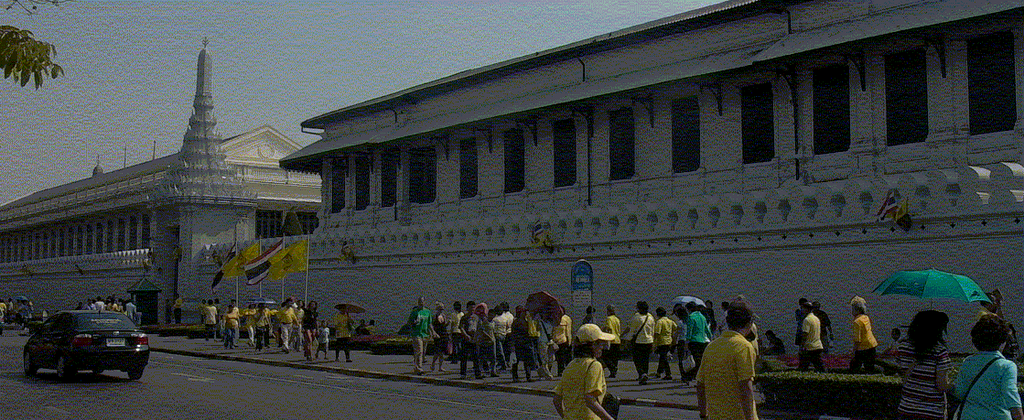
On New Year’s Day, despite the bomb that blasted in parts of Bangkok and killed three people, the streets were still swamped by tourists and locals paying homage to the many temples of Bangkok. Not much difference with previous days, except that on New Year’s Day, there were many more people wearing yellow t-shirts walking around – making an interesting landscape of yellow subjects moving at different tangents in different speed across the urban landscape.

The Thais love their king so much that every Monday, the day that the king was born, they would put on something yellow (the Thai royal color) to express their love for the king. Pictures of the king in different occasions can be found the moment you step your feet on Thai’s ground, and in about every other house and public places you go. Most were of his pictures in royal suits waving from a balcony. Others were his trips to the countryside, sitting on the floor discussing matters with local officials, and even of him touching a homeless person.

This past New Year’s Day coincided with Monday, and the cityscape is especially swarmed with yellows. The picture below is taken in front of the Grand Palace on January 1, 2007.


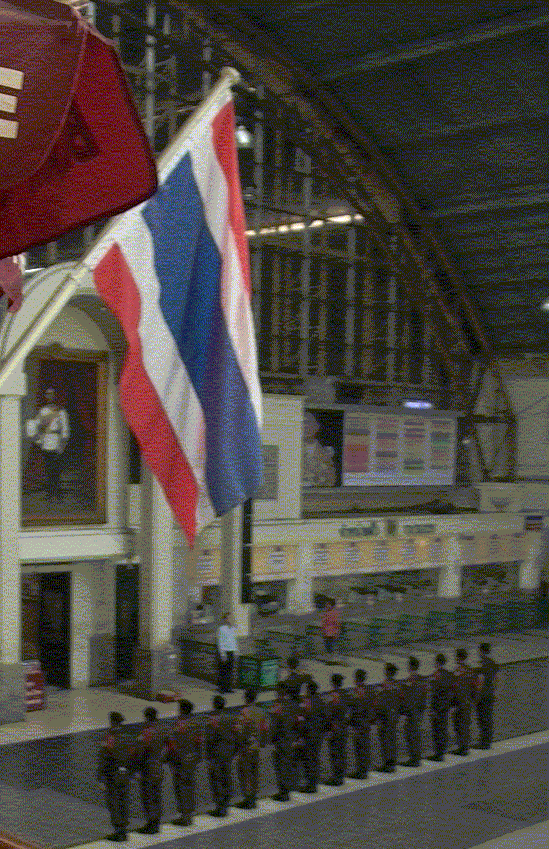
Still related with the sense of paying homage to the royal family as well as to the kingdom, at precisely 8 o’clock every morning, most public places like the sky train and train stations would turn on the national anthem on loudspeakers. And instantly, all activities were put on hold and everyone would stand on pause until the end of the song when suddenly, as if someone has pressed the play button again, people resume their activities. The picture below is taken at the Hua Lamphong Train Station on December 20, 2006.


An interesting pause in everyday life of the city, often colored by shades of yellows, but especially more so on Mondays.

Sunday, December 31, 2006

Taking Down [Hi-]Story & Making [Hi]Story

On December 30, 2006, as Saddam Husein was executed at Iraq’s dawn, a small community was woken up abruptly at Bangkok’s dawn by the sound of hammers knocking down doors, windows, and walls. The dawn is not the only aspect on how the stories relate.

Wang Lee community has been living in Chareon Krong 52 Lane by the Chao Phraya River in Bangkok. Renting out shop houses on a land that belongs to Wat Yannava for the past 80 to more than 100 years, they are currently under threat of eviction from this temple landlord.

Two years ago, the temple decided not to extend their leases, and instead offered the land out to gain much better profit from a developer. 40,000 Baht (US$1,100) was offered as compensation for a family and approximately half of the community accepted the offer and moved out. But the rest want to stay, for the reasons that they have no where else to go, and they have formed an interlinked of families that make up a living history of Bangkok.

Most of Wang Lee community members are descendants of Chinese immigrants in Bangkok, some still have three and few even four generations living under the same roof. Their shop houses are living proofs of historical trading between China and Thailand. Although the buildings do not fall under historical conservation of Bangkok, they are nevertheless constructed ingeniously for the local climate. The shop houses are designed to be naturally ventilated, crossing the opening on the first-floor of the shop front to a double- or a triple- floor height ceiling with manually-operable roofs for ventilation.

Nevertheless, these facts do not seem to matter for the temple landlord. For the past two years, the chief monk at the temple has not agreed to meet directly with the people, making them start a series of negotiations with various government agencies, and a social activism supported and facilitated by NGOs and university lecturers. The community has lost in a court battle against the temple, and although the community has applied to appeal the case, the temple landlord has set up a January 4, 2007 deadline for all tenants to move out.

Hoping that the appeal to the court will delay the deadline, the community did not expect some twenty construction workers to come early in the morning, on the long New Year Day weekend, before the deadline is actually due.


As I arrived at the area, some fourteen empty shop-houses were already partially demolished.

Anxious citizens, shouting, talking, standing, staring
Fingers typing and phones ringing, informing, repeating, urging
East to West pacing, policemen standing, sitting, idling

Displaced doors and windows, knocking, banging, moving
Wooden stacks and piles on concrete pavements, waiting
Knocked-down walls of hundred years, grieving

After knocking down security measures and making signifying holes in the shop houses, the construction workers abruptly left the premises. The act of terrorizing has been achieved. Nevertheless, the community has not given up their hopes in keeping their living history, thanks to political, governmental, social, civil, and academic supports they have received. Click here for Bangkok Post's version of the story.

As Saddam’s execution made the day’s world [hi-]story (history and/or hi-story), what to make of the living [hi]story (history and/or story) of Iraqis people? How much would his death really matter in the making of current and future suffering and/or happiness of most Iraqis people and others affected by Saddam’s life? As parts of Wang Lee’s shop houses became history, what to make of the living [hi]story of this historical community in Bangkok? They may or may not succeed in keeping their homes, yet what has been gained, or lost, during the process of taking down parts of the history?

What if the hi-story of major relevance to few (media and political, or private enterprise in this case) is replaced by the [hi]story of everyday people? Perhaps only then could everyone look forward to the New Year.

Tuesday, December 26, 2006

Have a Happy Holiday (Brought to You by ...)


Apologies for the long absence from blogging. I'm currently in Bangkok, conducting research on Bangkok's urban poor. More to report later when I have access to internet on a more regular basis. But for now, here's some pictures of Christmas in Bangkok, in which Christmas is not even a public holiday, but where Christmas is nevertheless celebrated - however commercially. The stars above the trees are of the sponsoring banks.

On a more sincere end: Wishing all of you a Happy Holiday and a Happy New Year.

Friday, October 27, 2006

Have a Branded Ied

As if holiday season has not been commercialized and transformed enough with mobile technology, here’s a text message I received from a friend that captures it all :)

Hatiku mungkin gak sebening XL atau secerah Mentari.
Banyak salah yang kubuat.
Fren, kuminta Simpati-mu.
Bebas-kan aku dengan maafmu.
Selamat Idul Fitri 1427H.
Semoga amal ibadah kita mendapat acungan Jempol di mata-Nya.

Sunday, October 22, 2006

Ied in/and Jakarta

The Ied is just around the corner now. Nicest time of the year to be in Jakarta: traffic-free streets and significantly reduced density. The atmosphere even feel almost eerie as you start wondering whether everyone has evacuated the city because they know something you don’t.

Holidays like the Ied here in Indonesia or Thanksgiving in America always make big impact on the density of cities, as millions of people are travelling to be with their families and relatives, or simply taking time off for a vacation away from home – wherever that may be.

In a city like Jakarta, where millions of its population are migrant workers (including myself), the impact of Ied is extremely significant. You suddenly realize how overly crowded the city is, and how inefficient it runs normally. And you start thinking how nice it would be to experience the city when your mood is not clouded by the irritation you get from being in traffic.

Enjoy it while it lasts! Happy holidays and Selamat Hari Raya Idul Fitri 1427 H.

Sunday, September 24, 2006

Pride before Function

Yesterday’s Kompas featured several articles on consumption. One of the articles here noted that according to AC Nielsen study, 93% of Indonesian consumers are recreational shoppers, while “only” 68% of American society –known as consumer society – are recreational shoppers [1]. Consumption of goods contributed to 66.5% of Indonesian gross national production in 2004, and it increased to 74% in year 2005.

In another article here, Rhenald Kasali noted that in Indonesian society:
Derajat seseorang dinilai berdasarkan apa yang Anda miliki atau apa yang Anda pakai. Untuk menunjukkan jati dirinya orang cenderung berbelanja berlebihan.
This may explain similar attitude in design of houses in Indonesia, where consumption rules. If you wonder what I mean, all you need to do is to drive along upper housing complexes part of Pantai Indah Kapuk, Pondok Indah (the main avenue), or Lippo Karawaci and you’ll see houses that look like wedding cakes (the extremely elaborate one with curly icings), in more elaborate shapes and colors, but in a scale so huge you’ll start wondering how many families actually live there.

My sister Yenna, who is a branding consultant, calls this “Pride before Function”. The term “Form Follows Function” (a principal associated with modernism movement in architecture) means that function should be the foundation for design and therefore guide the resulting form. The term “Pride before Function” means that whatever form the design takes and however well the design functions are not as important as the pride and prestige that the design would bring to the owners.

Following the quotation above, Rhenald Kasali wrote:

Prinsip ini berbeda benar dengan upaya membangun karakter bangsa yang menekankan pada kekuatan jati diri, mulai dari kematangan berpikir, kerendahhatian, pendidikan, dan kepedulian sosialnya.

Pretty scary, huh?

Note
[1]. The article mentioned that AC Nielsen survey covered only consumers with access to internet, only 8% of Indonesian society.

Thursday, August 31, 2006

Map & Sense of (In)security

Last Sunday, I was invited to be a guest on a radio talkshow at Radio Utan Kayu with Dahlia Citra, host and producer of "Cuma Perempuan". The talkshow highlighted the issue of public participation in urban planning in Jakarta, particularly on Jakarta's transportation. One of the listeners commented that she was afraid to take the public transportation because of the lack of security.

I too am afraid of taking Jakarta’s public transportation. The only time I tried to take it on my own was to go to a friend’s house which isn’t too far from my own. That one experience leaves a particular memory in my mind. Although I know the direction and the area (I normally drive), I had no idea which public transportation I should take, and I was feeling insecure. I didn’t want to ask a stranger on the street. So I asked the driver of the public transportation instead, which was no help, because he was more eager to have me on his angkot than letting me know which one I should have taken. At the end, I had to transfer three times to travel a distance of less than 8 kilometers in total.

This feeling of insecurity could have been reduced if I at least have a map on my hand, telling me which public transportation I should take. As part of a research I did for IASTE conference, my research assistant Bevani found out that the reason why such a map does not exist in Jakarta is because Jakarta’s Transportation Department (Dephub) does not even have such a map. Bevani found that public transportation routes in Jakarta was not established by the government, but rather, by private companies that proposed these routes to the government. Later when we mapped public transportation routes around South West Jakarta, predictably, most started or ended in commercial and/or residential areas and routes that are populated, creating routes that resemble a rhizome rather than one that create a coherent whole.