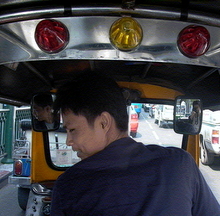
My everyday route around Jakarta includes picking up my sister in Kebayoran Baru area. If you happen to pass this area, you would know that some minor but significant changes have happened in the past month or two. In some intersections one could no longer take a left- or right- or u-turn because the police has constructed concrete portals.
At first it happened only in one intersection that the police might have found to cause traffic jam in the area. Later people (including myself) find another shortcut route that soon was closed off as well. But still we notorious shortcutters find another route that I’m hoping would not be closed off by the police.
For me it’s not simply a matter of finding the shortest possible route that I can pass through without breaking any traffic regulation. Rather, I find that Indonesian traffic regulation attempts to find shortcuts to problems that could not be solved simply by closing off streets and asking people to take a detour instead.
If the last shortcut I take now is closed off, it means that I would have to take more than 3 kilometer detour to travel the same distance. That detour would have added a total of 6 kilometer to my original round-trip route, additional cost for gas at around Rp.2.700,-, and additional 15-20 minutes every day. This is equal to 30 kilometer, Rp. 13.500,-, and 75-100 minutes every week. 120 kilometer, Rp.54.000,-, and 300-400 minutes every month.
This personal cost captures the big loss of Jakarta’s population in general. The Study on Integrated Transportation Master Plan (SITRAMP) funded by Japan International Cooperation Agency (JICA) estimated Jakarta’s traffic congestion caused the region to suffer annual economic loss in the amount of Rp.3,000 billion (US$ 315.7 million) for vehicle operating costs and Rp.2,500 billion (US$ 263.1 million) for travel time.
All too often temporary solutions are offered to solve problems that in turn create long-term repercussions. Instead of regulating shortcuts, perhaps the police should be thinking about how to create regulations to solve problems in the long-term.
Thursday, August 31, 2006


Speed Bumps
My brother told me the other day that he goes through 62 speed bumps during his 23 kilometer route from home to our sister’s office in Kebayoran Baru, to his office in Sudirman, and back home again. That’s incredible! True he goes by small streets, but still! It means on average, for every 370 meters of travel, he would have to pass one speed bump!
I started wondering why this is the case. In my ten years of living in the U.S., speed bumbs can rarely be found along the streets. So how does the police ensure that people don’t speed up in (heavily-populated) residential areas? The answer is because they have traffic regulations in the form of stop signs and speed limits that people actually follow. In Jakarta, such signs can rarely be found. If you ask me why, I would not know the answer.
But signs are definitely much cheaper than speed bumps! If we are skeptical about whether it would work, think about the time when we hear that the police decided to enforce car passengers to use seat belts. We thought that it wouldn’t work. But apparently it works better than expected. Perhaps it’s worth a try with traffic signs – before the bottom of our cars got too many bumps!
I started wondering why this is the case. In my ten years of living in the U.S., speed bumbs can rarely be found along the streets. So how does the police ensure that people don’t speed up in (heavily-populated) residential areas? The answer is because they have traffic regulations in the form of stop signs and speed limits that people actually follow. In Jakarta, such signs can rarely be found. If you ask me why, I would not know the answer.
But signs are definitely much cheaper than speed bumps! If we are skeptical about whether it would work, think about the time when we hear that the police decided to enforce car passengers to use seat belts. We thought that it wouldn’t work. But apparently it works better than expected. Perhaps it’s worth a try with traffic signs – before the bottom of our cars got too many bumps!
Map & Sense of (In)security
Last Sunday, I was invited to be a guest on a radio talkshow at Radio Utan Kayu with Dahlia Citra, host and producer of "Cuma Perempuan". The talkshow highlighted the issue of public participation in urban planning in Jakarta, particularly on Jakarta's transportation. One of the listeners commented that she was afraid to take the public transportation because of the lack of security.
I too am afraid of taking Jakarta’s public transportation. The only time I tried to take it on my own was to go to a friend’s house which isn’t too far from my own. That one experience leaves a particular memory in my mind. Although I know the direction and the area (I normally drive), I had no idea which public transportation I should take, and I was feeling insecure. I didn’t want to ask a stranger on the street. So I asked the driver of the public transportation instead, which was no help, because he was more eager to have me on his angkot than letting me know which one I should have taken. At the end, I had to transfer three times to travel a distance of less than 8 kilometers in total.
This feeling of insecurity could have been reduced if I at least have a map on my hand, telling me which public transportation I should take. As part of a research I did for IASTE conference, my research assistant Bevani found out that the reason why such a map does not exist in Jakarta is because Jakarta’s Transportation Department (Dephub) does not even have such a map. Bevani found that public transportation routes in Jakarta was not established by the government, but rather, by private companies that proposed these routes to the government. Later when we mapped public transportation routes around South West Jakarta, predictably, most started or ended in commercial and/or residential areas and routes that are populated, creating routes that resemble a rhizome rather than one that create a coherent whole.
I too am afraid of taking Jakarta’s public transportation. The only time I tried to take it on my own was to go to a friend’s house which isn’t too far from my own. That one experience leaves a particular memory in my mind. Although I know the direction and the area (I normally drive), I had no idea which public transportation I should take, and I was feeling insecure. I didn’t want to ask a stranger on the street. So I asked the driver of the public transportation instead, which was no help, because he was more eager to have me on his angkot than letting me know which one I should have taken. At the end, I had to transfer three times to travel a distance of less than 8 kilometers in total.
This feeling of insecurity could have been reduced if I at least have a map on my hand, telling me which public transportation I should take. As part of a research I did for IASTE conference, my research assistant Bevani found out that the reason why such a map does not exist in Jakarta is because Jakarta’s Transportation Department (Dephub) does not even have such a map. Bevani found that public transportation routes in Jakarta was not established by the government, but rather, by private companies that proposed these routes to the government. Later when we mapped public transportation routes around South West Jakarta, predictably, most started or ended in commercial and/or residential areas and routes that are populated, creating routes that resemble a rhizome rather than one that create a coherent whole.
Monday, July 17, 2006
Public space and social demarcations
Jakarta Post, Opinion and Editorial, March 18, 2006
When was the last time you were in a public space in Jakarta? If you don't use public transportation and hardly walk or bike on the streets of Jakarta, you might start thinking about malls, dining places or other entertainment places inside offices, hotels and other commercial complexes. Or you might think about parks, sports facilities, or other public areas including the streets inside your housing or apartment complexes.
You may want to think again, because all of these places may not be true public spaces, in the sense that they are not accessible to everyone. In other words, most malls, offices, hotels and other commercial complexes are privatized public spaces. Even when you spend hours of your time on Jakarta's congested streets inside your car -- you are in private property in a public space.
True public space in Jakarta is rarely frequented by members of the upper (or middle) class, while privatized public space is exclusive. The result, I am afraid, is further demarcation between the upper and lower classes of Jakarta.
Bestuzhev-Lada categorizes public space for leisure activities as "places for contemplation (religious buildings, parks, embankments), places to obtain new information (museums, libraries, exhibitions), places for creative activities (clubs, daily centers, etc.), places for sports activities (stadiums, sports centers), places for entertainment (dancing/concert halls, theaters), and places where public holidays are celebrated (squares, streets)" (Bestuzhev-Lada, 1972, in Gabidulina, 1994). Nowadays, it is questionable which of these places have remained true public space, as some, if not most of them, have been privatized.
What makes a public space privatized? Margaret Crawford reveals that the designs of most malls attempt to "create essentially a fantasy urbanism devoid of the city's negative aspects: weather, traffic, and poor people". She adds that malls are heavily patrolled to ensure safety of their homogeneous clientele by exclusion of others (Crawford, 1992).
Trevor Boddy, in arguing against privatized skyways, specifies that "two forms of policing kept the skyway system a haven of middle-class propriety: formal, by police officers at key entrance stairs and security guards in lobbies, and informal, through the visual codes and cues indicating that anyone not dressed appropriately or behaving in an acceptable manner is unwelcome" (Boddy, 1992).
The fast growth of malls in Jakarta after 1998 is linked by Abidin Kusno with "looseness" of power which triggers the feeling of insecurity among the formerly protected upper-middle class of Jakarta (Kusno, 2004). Malls have become safe havens for the upper-middle class, and I would include all privatized public space in this category.
Even when the upper (and some middle) class leave home (inside a housing or apartment complex), they are most likely moving around Jakarta in a private car, going from one private property to another without being part of public space. Being in the car, they are physically separated and psychologically removed from the activities and the people on the street by sheets of tempered glass and galvanized metals.
The car windows become screens though which the city is passively viewed, rather than a space in which we can actively participate. The city, the streets and the people outside become images, not too different perhaps from what we have seen on other screens like computers, televisions, movies. The public space is seen and experienced as visual stimuli -- the unwanted aspects we can both consciously and unconsciously filter or ignore.
Children from upper (and some middle) class who are born post-1998 are most likely growing up within homogeneous communities. They could become unaware of, insensitive toward and immune to lower-middle classes that are excluded from places they encounter in their daily lives. Nowadays in Jakarta, the only possibility for interaction among different socioeconomic groups of children are organized by schools under the umbrella of community work.
The way we design, use and experience Jakarta's public space has remarkably influenced our social interactions, and will surely have social implications. If we maintain the present conditions, we can only imagine the effect on the growing class division.
When was the last time you were in a public space in Jakarta? If you don't use public transportation and hardly walk or bike on the streets of Jakarta, you might start thinking about malls, dining places or other entertainment places inside offices, hotels and other commercial complexes. Or you might think about parks, sports facilities, or other public areas including the streets inside your housing or apartment complexes.
You may want to think again, because all of these places may not be true public spaces, in the sense that they are not accessible to everyone. In other words, most malls, offices, hotels and other commercial complexes are privatized public spaces. Even when you spend hours of your time on Jakarta's congested streets inside your car -- you are in private property in a public space.
True public space in Jakarta is rarely frequented by members of the upper (or middle) class, while privatized public space is exclusive. The result, I am afraid, is further demarcation between the upper and lower classes of Jakarta.
Bestuzhev-Lada categorizes public space for leisure activities as "places for contemplation (religious buildings, parks, embankments), places to obtain new information (museums, libraries, exhibitions), places for creative activities (clubs, daily centers, etc.), places for sports activities (stadiums, sports centers), places for entertainment (dancing/concert halls, theaters), and places where public holidays are celebrated (squares, streets)" (Bestuzhev-Lada, 1972, in Gabidulina, 1994). Nowadays, it is questionable which of these places have remained true public space, as some, if not most of them, have been privatized.
What makes a public space privatized? Margaret Crawford reveals that the designs of most malls attempt to "create essentially a fantasy urbanism devoid of the city's negative aspects: weather, traffic, and poor people". She adds that malls are heavily patrolled to ensure safety of their homogeneous clientele by exclusion of others (Crawford, 1992).
Trevor Boddy, in arguing against privatized skyways, specifies that "two forms of policing kept the skyway system a haven of middle-class propriety: formal, by police officers at key entrance stairs and security guards in lobbies, and informal, through the visual codes and cues indicating that anyone not dressed appropriately or behaving in an acceptable manner is unwelcome" (Boddy, 1992).
The fast growth of malls in Jakarta after 1998 is linked by Abidin Kusno with "looseness" of power which triggers the feeling of insecurity among the formerly protected upper-middle class of Jakarta (Kusno, 2004). Malls have become safe havens for the upper-middle class, and I would include all privatized public space in this category.
Even when the upper (and some middle) class leave home (inside a housing or apartment complex), they are most likely moving around Jakarta in a private car, going from one private property to another without being part of public space. Being in the car, they are physically separated and psychologically removed from the activities and the people on the street by sheets of tempered glass and galvanized metals.
The car windows become screens though which the city is passively viewed, rather than a space in which we can actively participate. The city, the streets and the people outside become images, not too different perhaps from what we have seen on other screens like computers, televisions, movies. The public space is seen and experienced as visual stimuli -- the unwanted aspects we can both consciously and unconsciously filter or ignore.
Children from upper (and some middle) class who are born post-1998 are most likely growing up within homogeneous communities. They could become unaware of, insensitive toward and immune to lower-middle classes that are excluded from places they encounter in their daily lives. Nowadays in Jakarta, the only possibility for interaction among different socioeconomic groups of children are organized by schools under the umbrella of community work.
The way we design, use and experience Jakarta's public space has remarkably influenced our social interactions, and will surely have social implications. If we maintain the present conditions, we can only imagine the effect on the growing class division.
Fortress mentality leaves Jakartans isolated, fearful
Jakarta Post, Opinion and Editorial, January 21, 2006.
A home should be a safe abode, thus security is important. A common solution to the security of Jakartan houses is to put bars on the windows facing the street. After the May 1998 riots, the use of security bars has proliferated, with all open spaces being covered, making their occupants feel caged in their own homes. Housing complexes that have been developed over the past ten years are more likely to be surrounded by three-meter walls, and can only be entered through secured gates.
Older middle-upper housing complexes, on the other hand, are not gated. I will argue that it is precisely this openness and inclusivity towards other racial, social and economic groups, that has strengthened social security.
Gated communities aim to exclude "others". Most of them don't allow street vendors and those who "don't belong" to enter the complexes. Caged-in houses can even be found within these complexes. It seems that the fear of "others", traditionally addressed towards those of a different race, social or economic status, has extended itself to become a generalized fear of everyone, period. The implication of gated communities is that they create pronounced social, economic and, in most cases, racial enclaves, that are in fact far more likely to trigger resentment and thus cause insecurity.
Mike Davis in City of Quartz (1990) suggests two reasons for explaining the phenomena of house fortresses in Los Angeles. "In the first place, the market provision of 'security' generates its own paranoid demand. 'Security' becomes a ... prestige symbol. Secondly, as William Whyte has observed of social intercourse in New York, 'fear proves itself'. The social perception of threat becomes a function of the security mobilization itself, not crime rates." Post-1998 housing complexes in Jakarta reveal similar paranoia, with security becoming a commodity rather than a real need against crime.
Older middle-upper housing complexes, such as Menteng, Kemang, and Permata Hijau, have no clear boundaries with plenty of open pedestrian and vehicular access to the surrounding (kampung) areas. According to David Hutama, an architect in Jakarta, the areas of Pulomas, Kayu Putih, Taman Buaran Indah and Bintaro are also ungated, and remain this way to this day.
Occupants of these complexes, although mostly from middle and upper social and economic groups, are racially mixed. Permata Hijau is considered by many as one of the most prestigious housing areas in Jakarta. Yet, here and there, smack right up against huge, multi-billion-rupiah houses, are informal settlements ranging from low-income houses, warung, and informal businesses.
Some security measures are taken. Security posts can be found at almost every other intersection, some streets are closed off after 10 p.m., and some houses even have their own security guards. But apart from that, Permata Hijau streets are open to kaki lima and kampung dwellers, some of whom work in or provide services to these houses, while others simply hang out. Some of the streets and vacant lots are even appropriated as public space where kampung dwellers play soccer or volleyball, while others are privately used as gardens maintained by kampung dwellers.
The welcoming stance towards the kampung dwellers brings a sense of belonging to the area that in fact helps prevent crime.
Clearly, securing our homes can be done effectively without the need to live in a fortress. Jane Jacobs proposed in The Death and Life of Great American Cities (1961) that the problem of insecurity can be solved by three means.
First, there must be a clear demarcation between what is public space and what is private space.
Second, there must be eyes upon the street; eyes belonging to those who we might call the natural proprietors of the street.
And third, sidewalks must be in continuous use by pedestrians.
As most houses are gated anyway, demarcation of public and private space is already clear in most cases. However, if you happen to drive through any of the newer housing complexes, the streets are almost vacant. Gated communities create a environment that alienates and excludes others.
This is not the case in Permata Hijau, and most other older housing areas, where the inclusion of dwellers has created natural proprietors who use the streets fairly continuously, and whose "eyes" are always present.
These older complexes demonstrate that it is not necessary to exclude pre-existing and surrounding communities. Moreover, open complexes create mutual benefits for both dwellers of the housing complexes and those from surrounding communities.
A home should be a safe abode, thus security is important. A common solution to the security of Jakartan houses is to put bars on the windows facing the street. After the May 1998 riots, the use of security bars has proliferated, with all open spaces being covered, making their occupants feel caged in their own homes. Housing complexes that have been developed over the past ten years are more likely to be surrounded by three-meter walls, and can only be entered through secured gates.
Older middle-upper housing complexes, on the other hand, are not gated. I will argue that it is precisely this openness and inclusivity towards other racial, social and economic groups, that has strengthened social security.
Gated communities aim to exclude "others". Most of them don't allow street vendors and those who "don't belong" to enter the complexes. Caged-in houses can even be found within these complexes. It seems that the fear of "others", traditionally addressed towards those of a different race, social or economic status, has extended itself to become a generalized fear of everyone, period. The implication of gated communities is that they create pronounced social, economic and, in most cases, racial enclaves, that are in fact far more likely to trigger resentment and thus cause insecurity.
Mike Davis in City of Quartz (1990) suggests two reasons for explaining the phenomena of house fortresses in Los Angeles. "In the first place, the market provision of 'security' generates its own paranoid demand. 'Security' becomes a ... prestige symbol. Secondly, as William Whyte has observed of social intercourse in New York, 'fear proves itself'. The social perception of threat becomes a function of the security mobilization itself, not crime rates." Post-1998 housing complexes in Jakarta reveal similar paranoia, with security becoming a commodity rather than a real need against crime.
Older middle-upper housing complexes, such as Menteng, Kemang, and Permata Hijau, have no clear boundaries with plenty of open pedestrian and vehicular access to the surrounding (kampung) areas. According to David Hutama, an architect in Jakarta, the areas of Pulomas, Kayu Putih, Taman Buaran Indah and Bintaro are also ungated, and remain this way to this day.
Occupants of these complexes, although mostly from middle and upper social and economic groups, are racially mixed. Permata Hijau is considered by many as one of the most prestigious housing areas in Jakarta. Yet, here and there, smack right up against huge, multi-billion-rupiah houses, are informal settlements ranging from low-income houses, warung, and informal businesses.
Some security measures are taken. Security posts can be found at almost every other intersection, some streets are closed off after 10 p.m., and some houses even have their own security guards. But apart from that, Permata Hijau streets are open to kaki lima and kampung dwellers, some of whom work in or provide services to these houses, while others simply hang out. Some of the streets and vacant lots are even appropriated as public space where kampung dwellers play soccer or volleyball, while others are privately used as gardens maintained by kampung dwellers.
The welcoming stance towards the kampung dwellers brings a sense of belonging to the area that in fact helps prevent crime.
Clearly, securing our homes can be done effectively without the need to live in a fortress. Jane Jacobs proposed in The Death and Life of Great American Cities (1961) that the problem of insecurity can be solved by three means.
First, there must be a clear demarcation between what is public space and what is private space.
Second, there must be eyes upon the street; eyes belonging to those who we might call the natural proprietors of the street.
And third, sidewalks must be in continuous use by pedestrians.
As most houses are gated anyway, demarcation of public and private space is already clear in most cases. However, if you happen to drive through any of the newer housing complexes, the streets are almost vacant. Gated communities create a environment that alienates and excludes others.
This is not the case in Permata Hijau, and most other older housing areas, where the inclusion of dwellers has created natural proprietors who use the streets fairly continuously, and whose "eyes" are always present.
These older complexes demonstrate that it is not necessary to exclude pre-existing and surrounding communities. Moreover, open complexes create mutual benefits for both dwellers of the housing complexes and those from surrounding communities.
Subscribe to:
Posts (Atom)